
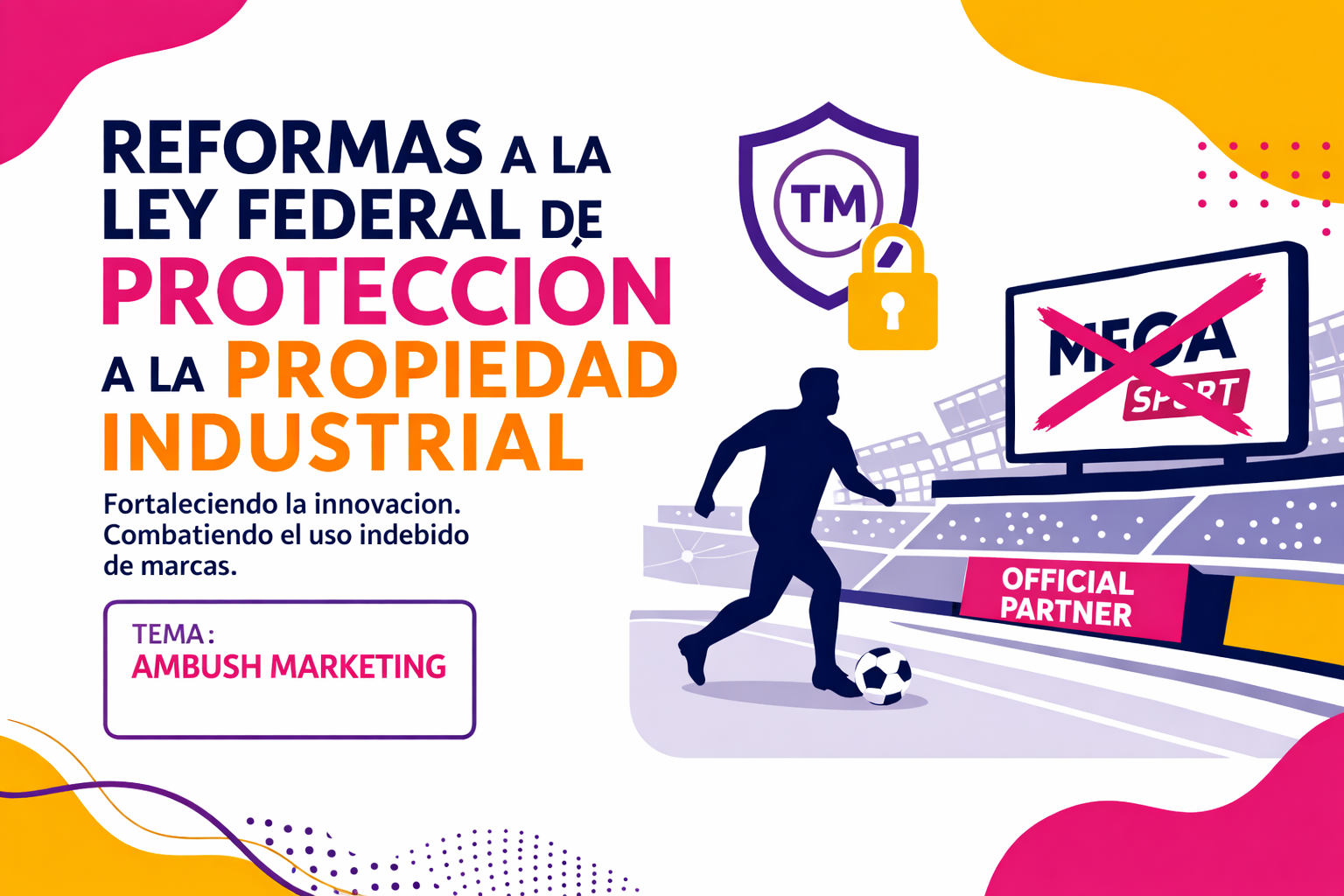
On March 18, a significant reform to the Federal Law on the Protection of Industrial Property was approved.
The intellectual property landscape in Mexico has shifted, focusing on streamlining prevention and enforcement with the recent reforms to the Federal Law on the Protection of Industrial Property (LFPPI).
For rights holders and marketing departments, this translates into more agile processes and stronger protection for events sponsored by their brands.
At the same time, it establishes new types of infringements that require evaluation, considering risks and opportunities, with a perspective of greater protection for trademark holders in the planning and creation of new products, services, and advertising campaigns.
Portfolio Optimization and New Barriers
The reforms to the law aim to expedite the registration process while simultaneously establishing new impediments closely related to the protection of cultural heritage.
Streamlined Registration: The Mexican Institute of Industrial Property (IMPI) will have a maximum of five months to grant trademark registrations in cases without oppositions or objections, allowing for more aggressive commercial activity.
New Prohibitions: The prohibition against registering technical/common phrases or sounds (e.g., the sound of running water to protect “bottled water”) is reinforced.
Furthermore, the registration of signs related to the country’s cultural heritage and indigenous communities is prohibited without prior authorization.
Apparent protection against “ambush marketing.”
The reform formally introduces a new sanctioned conduct that has been interpreted in the media as a direct prohibition against “ambush marketing,” a common practice whose scope now includes more precise prohibitions.
New Infraction: It is now classified as an administrative infraction to carry out acts that induce the public to unjustifiably assume an official sponsorship relationship with mass events, whether public or private.
Campaign Risks: The use of implicit references to events such as the World Cup or Formula 1, and even ticket giveaways that create this association, could trigger this conduct depending on the Authority’s analysis in each case.
Need for Judgment: Since the law allows for the IMPI’s interpretation of what constitutes “confusion or deception,” it is vital to have a prior legal analysis that validates the viability of your campaigns to determine whether or not a conduct creates an association as specific as the one prohibited by law.
AI and Liability: The user of the model is responsible for its infringements.
Liability for Automation: It is explicitly established that any infringement of the law will be sanctioned even if committed through the use of Artificial Intelligence. Implication: Companies will no longer be able to disclaim responsibility by claiming errors in algorithms or automated advertising processes; human legal oversight of AI is now a compliance requirement.
How does this impact your 2026 strategy?
The use of Mexicanism or cultural elements, as well as the line between a creative campaign and an administrative infraction for ambush marketing, has become very thin.
Intellectual property infringements produce significant contingencies and the possibility of precautionary measures that can paralyze a campaign.
It is natural that we face an Authority that, in addition to having a new tool to impose sanctions, is under pressure to do so now that it finds itself at the center of the world stage. But this does not mean that creating campaigns in the context of an event or celebrating Mexican identity is impossible.
Creative Solutions
At ALBOR, we navigate changing landscapes, always seeking to preserve our clients’ creativity.
It is important to determine the position we are playing, and for this, it makes perfect sense to audit your intellectual property assets and validate the advertising campaigns you have planned or in development under these new legal standards, ensuring that your innovation is protected and within the lowest risk scenario.
Let’s prepare a defensible campaign (the evidentiary standard for the official sponsor remains high).
Let’s explore how to distance ourselves from the official sponsor without losing sight of the moment.
Let’s develop brands that capture the Mexican moment without risking registration bans.